
Daggett County Property Tax Records
Daggett County property tax records live in two offices. The Assessor keeps the value roll. The Treasurer handles bills, payment channels, and delinquency notices. Not every assessor-card field or online bill form is published on the county site, so the table pairs each record with the office to ask rather than promising one combined online result. A parcel number and the tax year will get you started with either office.
| Field | What It Shows | Where |
|---|---|---|
| Fair-market value | Annual value as of the January 1 lien date | Daggett County Assessor |
| Taxable value | Value after any qualifying exemption | Assessor notice or roll |
| Residential exemption | Eligibility and taxable share when approved | Assessor record and notice |
| Tax notice and amount due | Final rates, taxes, and due information | Daggett County Treasurer |
| Payment and delinquency | Payment channels and dated delinquent list | County tax information page |
A parcel's fair-market value is set by the assessor for the tax year, but taxable value can shrink when an exemption applies. Tax rates and other adjustments also shape the final bill. Because of this, a shift in value rarely moves the tax due by the same percentage.
Daggett County Tax-Year Calendar
Utah uses fair-market value as of January 1 for locally assessed real property. Daggett County mails a disclosure notice in July, then the final rates and taxes are set in September and tax notices are sent in October. The county says notices go out no later than October 20. Real-property taxes are due November 30, with the following Monday used when that date falls on a weekend.
The calendar separates the value review from payment. A July disclosure notice is not the final tax bill. A parcel owner who does not receive a notice should contact the county office shown on the current notice or the official Treasurer page. Keep the parcel number and mailing address current so the county's mail reaches the right place.
Daggett County Residential Exemption
Utah's primary-residential exemption generally removes 45 percent of fair-market value from taxation. The remaining 55 percent stays taxable when the property qualifies. The state defines a qualifying home as a primary residence used for 183 consecutive days. It covers up to one acre and improvements. The Assessor can confirm the application and the parcel-card field. The county publishes no public application form or sample parcel result.
The assessment notice shows whether relief was applied. Do not infer eligibility from a mailing address or a map. A seasonal cabin can carry an out-of-county mailing address. An exemption classification is a tax status, not proof that anyone lives there. Utah's primary-residential-exemption guidance posts the statewide rules and forms.
Daggett County Tax Lookup Fields
The Daggett County tax page explains how to pay and where dated delinquency information appears, but it offers no search form or sample bill result. Have a parcel number and tax year ready. Expect to call the Treasurer for fields the county does not post online.
| Lookup detail | What is documented | Online field status |
|---|---|---|
| Parcel number | Required on mailed payment; separate payment per parcel | Search field not exposed |
| Tax year and notice | Annual disclosure and final tax notice are mailed | Result screen not captured |
| Amount and payment status | Treasurer handles tax payments and delinquency | Search fields not published |
| Value and exemption | Assessor determines value and records exemption | Parcel-card labels not verified |
Looking Up a Daggett County Tax Bill
The Daggett County tax page describes payment routes and Treasurer contacts. But the county publishes no searchable bill interface. A current notice, a parcel number, or a mailed coupon is the safest starting clue. The Treasurer requires a separate payment for each parcel. A lookup link may fail. Call the office listed on the official page instead of guessing at account numbers.
- Use the parcel number on the tax notice or coupon when contacting the Treasurer.
- Check the current notice for final rates, amount due, and the annual due date.
- Ask the Assessor about the valuation and any residential exemption shown for the parcel.
- Review the dated delinquent list separately; a delinquency entry is not a title change.
- Fair-market value
- The Assessor's estimate of value for the January 1 tax lien date.
- Taxable value
- The value remaining after an approved exemption is applied.
- Primary-residential exemption
- Utah relief for a qualifying primary residence; the county notice shows whether it is applied.
- Tax lien
- A claim tied to unpaid taxes; check the Treasurer and any recorded instrument.
Daggett County Tax Coupons
The Daggett County Treasurer can mail you a prepayment coupon booklet. It is based on the previous year's tax. The booklet holds nine monthly coupons, January through September. The tenth payment rides on the October notice. That final amount differs because values and rates are not set until September.
The county's payment page lists online, phone, mail, and counter options. Instant Payments adds a 2.5 percent charge, or a $2.50 minimum. Each parcel needs its own payment. A check or money order to PO Box 400 in Manila should carry the parcel number. Counter payment is available at the courthouse.
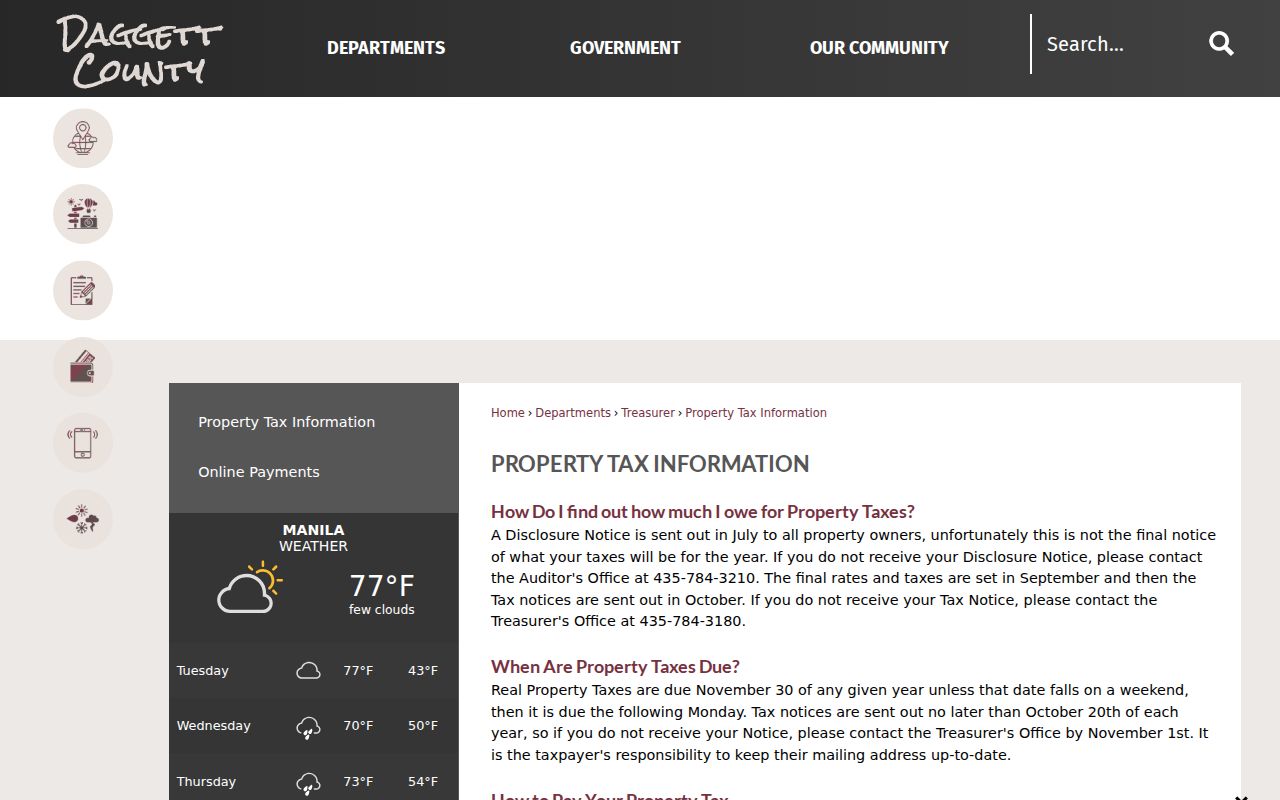
The county payment page posts the current options and balance details.
Daggett County Delinquent Taxes
Daggett County property tax records include a Treasurer delinquent-tax list PDF. The records also list the penalties and interest that accrue on unpaid balances. The list carries a publication date. That date matters as much as the parcel and amount. A later payment or correction will not appear in an older copy. Check the live county notice before acting on a saved document's balance. Call the Treasurer too.
A delinquency is not proof of a sale, foreclosure, or transfer. To learn whether title changed, look for later Recorder instruments and public court records. Tax status answers a money question. Deeds and judgments answer who holds a recorded interest.
Daggett County Tax Roll Copies
Daggett County property tax records come in several paid formats. The fee schedule prices master tax-roll copies at $1.50 per page. A full tax-roll CSV runs $200 per year. Other listings include a $5 abstract. Property-record entry subscriptions cost $20 monthly or $50 yearly, and a parcel shapefile runs $500 per year. Each product serves a different purpose. A one-parcel lookup is not a bulk data order, so treat them separately.
Before ordering anything, ask the county for the current fee schedule and format. A CSV lets you compare values across many parcels at once. Still, it cannot replace a parcel-specific notice or prove what a property sold for. Zero in on a single value question first. The assessment notice and the Assessor are the right starting point there. For a delinquent balance, the Treasurer's current page is the place to go.
Requesting Daggett County Tax Roll Detail
Daggett County does not publish a complete public parcel-card result. So ask the Assessor directly. Ask which value, exemption, and assessment-year details can be released for a given parcel. Payment balances are a different matter. Route those questions to the Treasurer instead, since delinquency status lives with that office.
Any request should name the parcel number and the tax year. It should also name the exact record or field you want. That precision matters. Splitting an assessment question from a payment question also helps. The county can then send it to the correct office the first time.
Some copies or data products are not online. Utah GRAMA is then the formal request process for records a public entity holds. State law generally demands a response within 10 business days. That window shrinks to five business days when a request serves the public. The county may charge reasonable actual preparation and duplication costs. Separately, Daggett County lists the $1.50-per-page master tax-roll copy and its $200 annual CSV. Confirm the current fee and format before asking for bulk information. One caution applies: never assume a map popup holds every field in the tax roll.
Appealing a Daggett County Assessment
Utah values locally held property at fair-market value each January 1. Daggett County mails the valuation notice by July 22. From there, the county Board of Equalization usually sets a September 15 appeal deadline. Check the current state notice and county instructions. They control the exact filing date, evidence, and form for that tax year. Remember what an appeal actually decides. The question is whether the market value is right. The board never sets the tax rate. Compare the notice against your property facts and recent similar sales. Then follow the appeal directions printed for that year.
Appeal window. Review the Daggett notice and the Utah Tax Commission's current locally assessed appeal instructions. The usual deadline is September 15, with later appeal steps subject to separate dates.
A county Board of Equalization decision is not always the end. The Tax Commission allows a further appeal, generally due within 30 days of that decision. Evidence must tie back to the January 1 value. It can also address equalization for the tax year in question. Keep everything in one file. Include the notice, sales comparisons, an appraisal or closing evidence, and the county's response. Timing in tax records is strict. Use the current state instructions rather than an old schedule. Hold onto the July valuation notice and any written decision. Pair them with the parcel's October tax bill. Daggett County sends that bill no later than October 20.