
Daggett County Deed Records
The Recorder's page names four index families: grantor and grantee, tract, mortgage, and lien. A deed records a transfer. Related instruments differ. Mortgages secure debt, releases clear it, and court orders or parcel changes can reshape what a deed covers. The county page shows no live instrument-type menu or sample result. Match any label to the recorded instrument itself.
| Deed Type | What It Does | Common Use |
|---|---|---|
| Warranty deed | States the transferor's deed promises | Compare its terms with the title review |
| Quitclaim deed | Transfers whatever interest the signer holds | Check the parties and legal description |
| Executor or administrator deed | May convey estate land under authority | Read with the probate order or case |
| Judgment or decree | May affect title, possession, or partition | Confirm the final order and recording |
| Mortgage or reconveyance | Shows a security filing or later release | Search both the lien and release trail |
A deed transfers an interest. Mortgages and liens are encumbrances. They attach to the land or to a party, and a reconveyance or release is a separate record worth hunting for, since a paid loan does not clear itself.
Daggett County Index Families
The Recorder's page names five index routes: entry, grantor and grantee, mortgage, tract, and lien. It names no public web form. The index categories are listed; the search screen's details are not. No earliest online year is stated. The state Archives keeps the older indexes permanently. When an electronic result is missing, a counter visit or a direct question to the Recorder is the safe route.
| Index family | What the county names | Detail not published online |
|---|---|---|
| Grantor and grantee | Party-based indexes | Exact field labels, coverage start, image access |
| Tract | Land-description index | How current parcel wording is keyed |
| Mortgage and lien | Encumbrance indexes | Live search options and release matching |
| Entry | Recorder index category | Document types and result inventory |
The Daggett County Recorder's official page gives the office contact and the index categories. Call 435-784-3180 or visit the Manila counter instead.
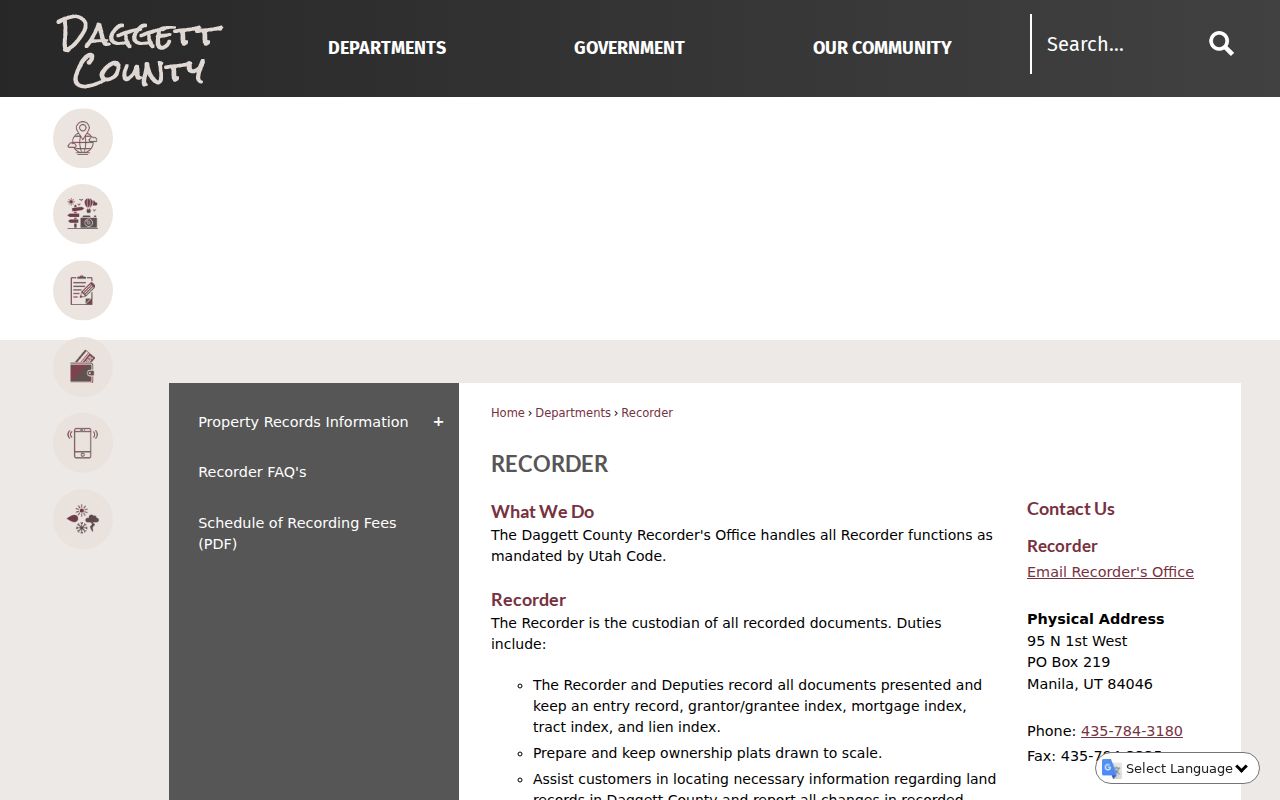
The county page documents the index families. With no sample result shown, the search screen's exact output still needs confirmation at the counter.
Daggett County Grantor and Grantee Index
A grantor conveys an interest. A grantee receives it. Tracing Daggett County deed records works like a chain, where today's grantee becomes the next grantor to search in the earlier deed. Follow the land, not just the name. The Recorder's tract index helps test whether two similar names point to the same parcel.
- Start with the known grantee, parcel, or legal description and locate the latest matching deed entry.
- Record the parties, instrument date, recording reference, and complete legal description.
- Search the prior grantor as a grantee, then compare the next deed's description to the same land.
- Repeat until the index or volume ends; the county has not published an online cutoff year.
- Grantor
- The party conveying an interest in the instrument.
- Grantee
- The party receiving an interest in the instrument.
- Chain of title
- The sequence of recorded transfers used to trace interests in a parcel.
- Index entry
- A pointer to a recorded item; confirm its image or certified copy with the custodian.
Daggett County's 1956 Volume Shift
Utah State Archives series 17552 draws a line at 1956. Before that year, Daggett County official records lived in separate volumes. From 1956 on, records were registered together as well as separately. That shift shapes how an older deed search is organized. It says nothing about online coverage.
The Archives calls the grantor and grantee indexes permanent. Deeds sit alongside final judgments and decrees affecting title or possession. An apparent gap may just be a volume question. Ask the Recorder which volume or index applies. Then compare that answer with the Archives catalog. Do not assume anything was lost. The Utah State Archives Daggett series catalog describes the permanent index collection.
The archive page is only a starting point. Confirm exact deed-book runs and custody before citing any older Daggett County year.
Daggett County Mortgage and Lien Trail
Daggett County's Recorder indexes mortgages and liens alongside deeds. The county's Property Watch notice names liens and reconveyances among the changes that can trigger an alert. Search the related release, not just the original filing. A payoff alone never proves a reconveyance, satisfaction, or release was recorded.
When a lien went through the courts, pair the recorded notice with the Utah Courts XChange case history. A docket shows a filing or judgment. The Recorder's index shows instruments filed against the land, so neither source replaces the other. Check both. Read the final order and any later release before concluding anything about the encumbrance.
Daggett County Deed Alerts
Property Watch is free for Daggett residents. It emails alerts when deeds, liens, or reconveyance deeds are recorded. Sign up in person, through the online form, or by emailing the Recorder/Treasurer. An email signup needs a parcel number, a name, a preferred email, and a phone number. Phone enrollment is not accepted. The county's July 2023 Property Watch notice explains the service. When an alert names a document, pull that instrument from the Recorder. Check the parcel description and the parties. An alert alone proves nothing about validity.
An alert only points the way. It directs a resident toward a new filing that deserves a direct look at the Recorder's office.
Daggett County Recorder Copies
The Recorder's published $45 charge is a recording fee. It is not a stated deed-copy price. The office publishes no copy or certification schedule and no mail-copy form. Ask about plain and certified copies first. Confirm accepted payment, and whether an index or image can be viewed before a request goes in. The Manila office is open Monday through Friday, 9 a.m. to 4 p.m.
For an off-site Daggett County deed records request, gather the parties, a likely instrument date, and the parcel or legal description. Naming the index family helps. That narrows the search without inventing a document number. For older entries, mention the separate-volume period. Ask whether the Recorder or the State Archives holds the volume.
Daggett County Court and Deed Records
Courts and recorders answer different questions. A recorded final judgment can affect title even though it never appears in the Daggett County deed books. Utah Courts XChange opens district and justice case information to the public, with most district courts carrying CORIS-era coverage from the late 1990s. Documents from July 1, 2010 onward are generally available. Older converted cases may show less detail. Some case types or filings stay private.
For partition, quiet-title, foreclosure, or lien enforcement, locate the public case and read the final order. Then see whether a related instrument was recorded. A case result alone is not a deed, and a deed entry alone may not explain a pending dispute.
Requesting Daggett County Deed Records
When the index or an instrument image is not online, send a focused request to the Daggett County Recorder, the custodian of county land records. Give the staff something to work with. Include the party names, an approximate recording or transfer date, the parcel number, and the legal description if you know it. Say exactly what you want. That could mean inspecting an index, getting a plain copy, receiving a certified copy, or searching a set date range. Naming the likely index family, such as grantor/grantee, tract, mortgage, or lien, beats a general request for every deed tied to a person.
Utah GRAMA sets the clock. A government entity generally responds within 10 business days. Demonstrated expedited public benefit can shrink that window to five. The law permits reasonable actual preparation and copy costs. Daggett County's $45 recording charge is not a published deed-copy price, and the product schedule sets no plain or certified instrument-copy fee either. Ask the Recorder for current charges and delivery options before you send payment. Some records stay classified. The custodian makes that call.
Older entries live in separate deed books or the permanent State Archives index series. Say so in your request. If a record sits outside the county's current access route, ask whether the Recorder or Utah State Archives holds the relevant book. A direct question saves everyone time.
Getting a Daggett County Deed Copy
Start with a simple question. Ask the Daggett County Recorder which index route will locate the deed filing, and whether a copy can go out by mail or over the counter. The public page lists the recording fee only. It states no copy or certification price and documents no online image access. Have the instrument parties and parcel description ready before you order. Confirm payment and delivery steps with the office.
Recorded, not guaranteed. The Daggett County deed index shows documents filed with the Recorder; it is not a title opinion, and an unrecorded interest or unresolved court matter may require separate review.